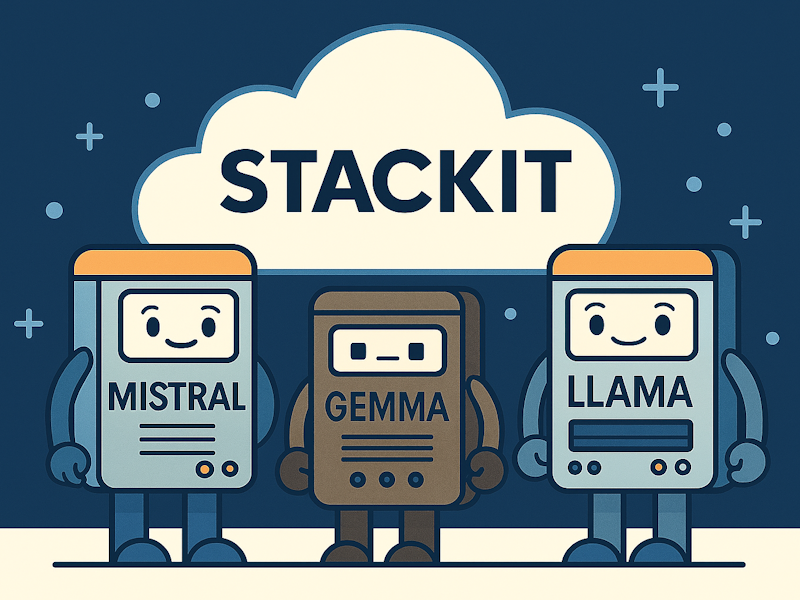
STACKIT AI Model Serving is the STACKIT service for cloud-hosted LLMs. It is an easy-to-use service that exposes Large Language Models through OpenAI API compatible endpoints. At the time of writing, there are 9 models available: 7 chat and 2 embedding models.
Available models at STACKIT AI Model Serving
The official documentation page for available models is STACKIT Docs: Available Shared Models of STACKIT AI Model Serving.
Chat Models
| gpt-oss-120b | |
| Developer | Open AI |
| Size | 120B params |
| Input €/M | €0.45 |
| Output €/M | €0.65 |
| Best Use Case | A reasoning-centric open-weight model designed for deep reasoning, tool use, and agentic applications such as RAG systems, code assistants, and AI tools with long-context (131K) processing. The go-to choice when high-quality reasoning and reliable tool calling are the priority. |
| gpt-oss-20B | |
| Developer | Open AI |
| Size | 20B params |
| Input €/M | €0.15 |
| Output €/M | €0.25 |
| Best Use Case | A cost- and latency-optimized sibling of GPT-OSS 120B (4-bit MXFP4) targeting responsive, real-time chat interactions and high-throughput assistant tasks. Best when speed and affordability matter more than peak reasoning, with a caveat that tool-calling reliability is lower than the larger models. |
| Qwen3-VL 235B | |
| Developer | Qwen |
| Size | 235B params |
| Input €/M | €1.50 |
| Output €/M | €1.75 |
| Best Use Case | The most capable vision-language model in the lineup, purpose-built for autonomous GUI interaction on PCs/mobile devices, visual coding (generating HTML/CSS/JS or Draw.io diagrams from images/video), advanced spatial reasoning with 2D/3D grounding for embodied AI, and multilingual OCR across 32 languages. Best suited for complex multimodal agentic and document-understanding tasks. |
| Qwen3.6 27B | |
| Developer | Qwen |
| Size | 27B params |
| Input €/M | €0.45 |
| Output €/M | €0.65 |
| Best Use Case | A coding-focused assistant model with a 262K context window, optimized for code generation, code review, debugging, technical reasoning, agentic AI, and RAG over large codebases. Ideal when you need strong developer-tool capabilities with long-context handling of complex multi-step workflows. |
| Gemma 3 27B | |
| Developer | |
| Size | 27B params |
| Input €/M | €0.45 |
| Output €/M | €0.65 |
| Best Use Case | A lightweight multimodal model handling text and image input, suited for image understanding, visual document understanding, QA, summarization, and reasoning with multilingual support (140+ languages). Being replaced by Gemma 4. |
| Gemma 4 31B | |
| Developer | |
| Size | 31B params |
| Input €/M | €0.45 |
| Output €/M | €0.65 |
| Best Use Case | The successor to Gemma 3, multimodal (text + image) with an expanded 256K context window and improved reasoning, explicitly tuned for agent-based workflows. Use for image understanding, visual document understanding, agentic AI, RAG, code generation, and chatbots where a large context and vision are needed. |
| Llama 3.3 70B | |
| Developer | Meta |
| Size | 70B params |
| Input €/M | €0.45 |
| Output €/M | €0.65 |
| Best Use Case | A general-purpose multilingual chat assistant (8 supported languages) fine-tuned for general question answering, agentic AI, RAG, code generation, and chatbots. It matches the quality of the much larger Llama 3.1 405B while remaining practical to serve, making it a solid all-rounder for general assistant workloads. |
Embedding Models
| E5 Mistral 7B | |
| Developer | Mistral |
| Size | 7B params |
| Input €/M | €0.02 |
| Best Use Case | A text-only embedding model (no chat) specialized in passage ranking and retrieval for English-heavy workloads, with 4096-dim vectors and up to 4096 input tokens. The standard choice for building text RAG and search pipelines. |
| Qwen3 Vision-Language Embedding | |
| Developer | Qwen |
| Size | 8B params |
| Input €/M | €0.08 |
| Best Use Case | A multimodal embedding model that maps both text and images into a unified semantic vector space, enabling cross-modal retrieval (text→image, image→document search) in 30+ languages, with up to 32K input tokens and configurable output dimensions via Matryoshka Representation Learning. Use it for multi-modal RAG and mixed-media search pipelines. |
AI Model Serving Pricing
Taking Llama 3.3 70B as a benchmark, STACKIT AI Model Serving offers very competitive pricing compared to OVHcloud AI Endpoints and other cloud vendors. Only Azure is cheaper. All other vendors are charging more per token, including AWS.
| Vendor | Model | Input €/1M | Output €/1M |
|---|---|---|---|
 IONOS AI Model Hub | Llama 3.3 70B | 0,65 € | 0,65 € |
 Scaleway Generative APIs | Llama 3.3 70B | 0,90 € | 0,90 € |
 OVHcloud AI Endpoints | Llama 3.3 70B | 0,79 € | 0,79 € |
 AWS Bedrock | Llama 3.3 70B | 0,72 € | 0,72 € |
 STACKIT AI Model Serving | Llama 3.3 70B | 0,45 € | 0,65 € |
 Berget AI | Llama 3.3 70B | 0,90 € | 0,90 € |
 Azure AI | Llama 3.3 70B | 0,268 € | 0,354 € |
Use STACKIT AI Model Serving LLMs with OpenAI API
Using the models with STACKIT AI Model Serving is straightforward and easy. In the STACKIT console, navigate to AI Model Serving.
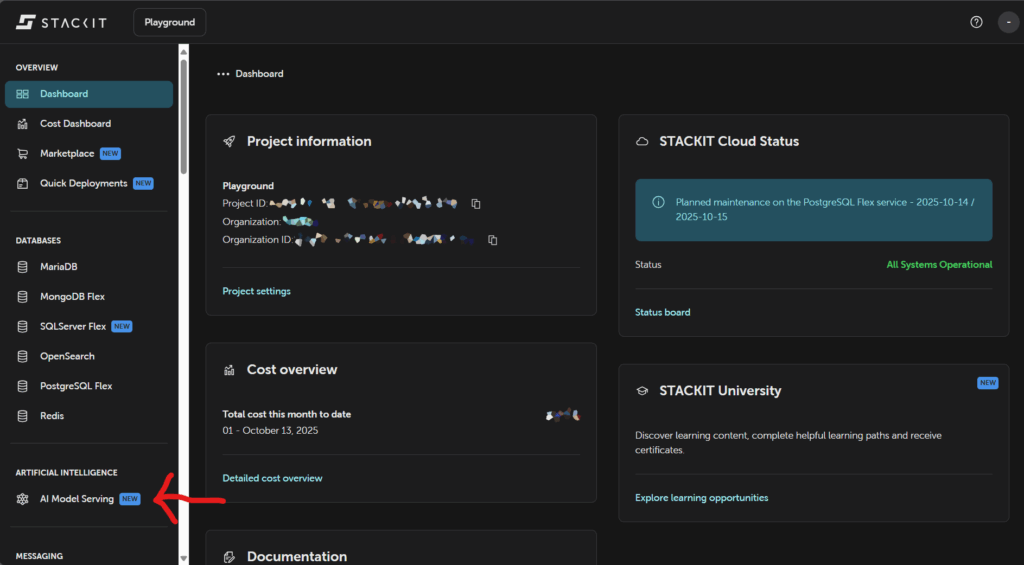
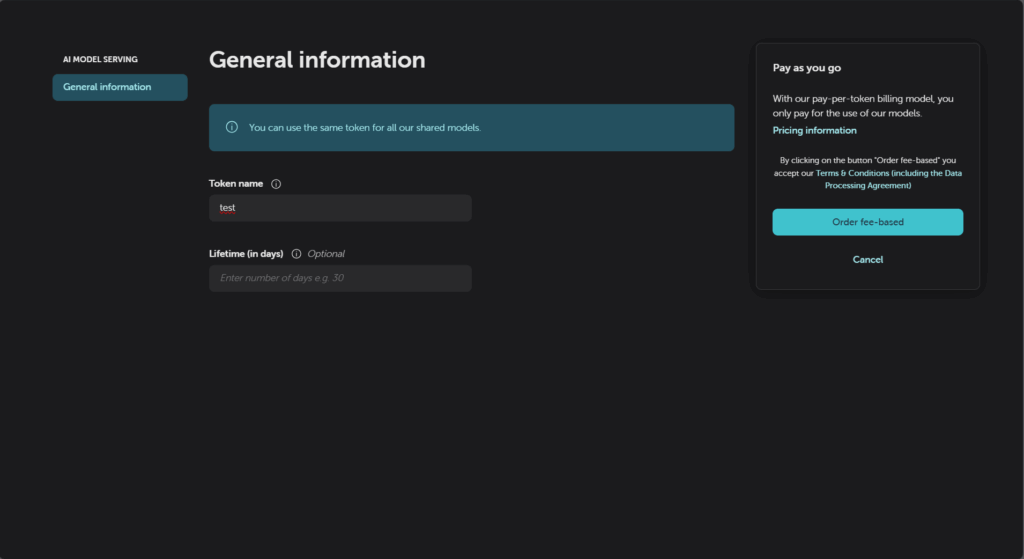
In the AI Model Serving section, create a token. To create a token, a name and the token lifetime must be specified.
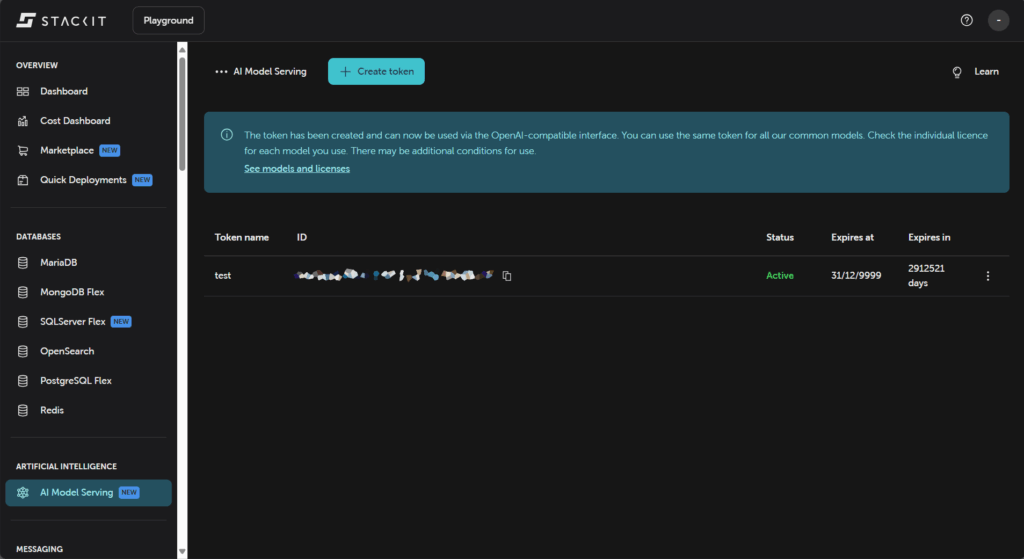
Once the token is created it can be used with all STACKIT AI Model Serving models via an OpenAI-compatible interface.
Outlook
STACKIT AI Model Serving is as easy to use as it gets and has very competitive pricing. I hope that the available models are just the start and that more and stronger models are following soon.