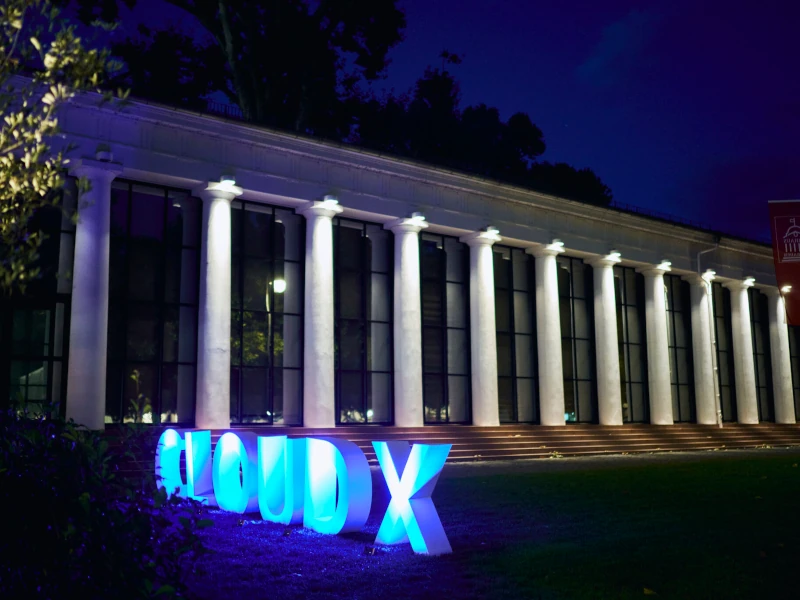
Two weeks have passed since the Cloud X Summit. Time to look back and reflect. Here are my impressions.
The event itself was a large step up from the year before with a much larger audience and great event organization. The Polizeiorchester Baden-Württemberg on the main stage, smaller music groups and beatbox duos roaming around in breaks, Bernie Wagner catching a drone in his keynote, good food with many options for every taste, sharp moderation, and overall a very fresh and “cool” and modern summit.

Takeaway 1: Growing relevance through new partnerships
Several partnerships were announced in the summit that are further strengthening the relevance of the STACKIT cloud platform and that should lower the barrier of moving to STACKIT:
- a very basic first step of a collaboration with Snowflake. The step means that it will be possible to replicate Snowflake data to STACKIT. Not too impressive yet, but a start on the journey.
- Celonis on STACKIT was announced (more about it here).
- ZScaler on STACKIT was announced (more about it here).
- Schwarz Digits is partnering with Dutch KPN to bring STACKIT to the Netherlands. The joint solution is going to be called KPN European Sovereign Cloud, powered by STACKIT.
While purists often criticize Schwarz Digits for partnering with non-European companies – creating what some call a “sovereign grey zone” – I believe this is the most pragmatic and realistic path forward. Offering clients already building on Snowflake an entry point lowers the barrier to adoption. Partnerships like these make it progressively easier to say yes to the platform.
Not a partnership, but another announcement that significantly boosts relevance, is that STACKIT Distributed Cloud is on track to receive VS-NfD clearance. This would open the door to classified workloads that previously could not be considered for the cloud at all.
Takeaway 2: Messaging focused on getting people from interest to action
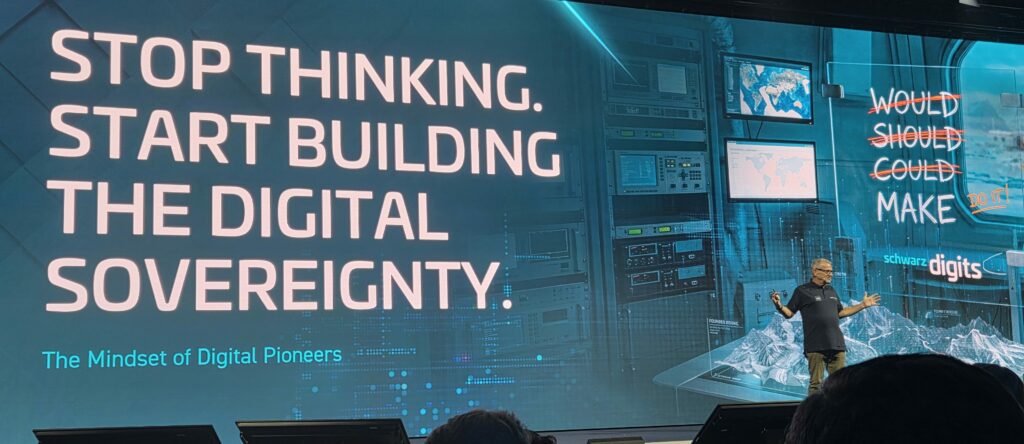
Much of the communication was focused on getting people from interest to action. Undoubtedly, STACKIT has created a lot of buzz in the market and has received a lot of interest. I think it is fair to speculate that it has proven more difficult than maybe expected to turn this interest into actual paying customers. This speculation would be in line with the Manager Magazin article about Schwarz Digits (see below).
Even more important that STACKIT representatives made it absolutely clear that STACKIT is here to stay and that Schwarz Group itself is fully betting on the platform. “If it is good for a 600.000 FTE corporation, it should be good for everybody else”.
I found the idea of establishing itself as a trust broker for IT products in Europe particularly interesting. It’s an ambitious vision, since trust is hard to earn and easy to lose. Through all the partnerships mentioned above, Schwarz Digits is actively working to position STACKIT as the central platform within a sovereign ecosystem. I think this is a very sound strategy: the ecosystem is just as important as the platform itself, and as more companies join, it can create a trust flywheel. This might be the answer to the challenge Bert Hubert describes in his piece “AWS and Microsoft are selling much more than cloud services“: European cloud providers must not only compete on the technical platform, but also reach a point where “no one ever got fired for buying [European provider]”.

The “Manager Magazin” article
One thing that didn’t help was an article in the German Manager Magazin from last September: “Rückschlag für Lidl – Was vom Angriff auf Big Tech übrig bleibt” (“Setback for Lidl – what’s left of the attack on Big Tech”). Bernie Wagner referenced it in his keynote on both mornings. So what did the article actually say?
The headline is decidedly clickbait, flatly declaring that STACKIT has failed. Yet nowhere in the article do the authors actually pinpoint why they suspect failure. Have they learned that Schwarz Digits has halted development? Didn’t they just announce another six-billion-euro data centre investment near Rostock?

Let’s take a closer look at how the authors construct their argument, which rests on four pieces of circumstantial evidence:
- Rolf Schumann has left the Schwarz Digits CEO duo, seemingly from one day to the other.
My comment: The sudden (at least looking from the outside) departure of Rolf Schumann does indeed raise questions. There are certainly conclusions to be drawn regarding future strategic direction, power play inside the company, and perhaps regarding individual characters. To declare the attack on big tech failed because Schumann left is, well, creative. - The articles quotes Schwarz Digits internal meetings that apparently were heated and where disagreement were voiced. Specifically, people voiced concerns with the “fake it till you make it” sales approach. Indeed, Schwarz Digits is creating a lot of noise and getting a lot of attention. The product development is having a hard time to match the pace and to meet all the requirements resulting from this high interest.
My comment: anybody working in the software industry knows this conflict and knows sales teams selling features that aren’t even built. Given the (yes, self-created) attention and pressure on STACKIT sales and product teams, such conflicts and internal discussions are totally expected and normal. To me, it is a sign of organisational health if those conflicts are being openly discussed. Such stories are certainly not a sign of failure. - A central piece of evidence in the article for the so called failure is that revenue for Schwarz Digits does not come as quickly as maybe hoped for. The Schwarz Group itself is still the largest customer on the STACKIT platform.
My comment: while it might be true that revenue is lagging targets, I see not the slightest bit of slowing down. Just in XXX, STACKIT announced one more data centre investment near the town of Rostock – worth up to 6 billion euro. It might be true that some people were hoping things would move quicker, both in product development and on the revenue side. Is this failure? No. A reality check maybe. But as STACKIT representatives keep repeating: “we are here to stay”. Nothing has changed. - A particularly strange argument is that Schwarz Gruppe is still working with US companies and Lidl and Kaufland still have infrastructure on Microsoft Azure and in Google Cloud.
My comment: For a 600.000 FTE company, the Schwarz Group is moving fast. Furthermore, it does not make sense to throw the baby out with the bathwater. It’s a long way. - One point I’d concede to the Manager Magazin authors: the investments in XM Cyber and Aleph Alpha have not paid off. In my view, it’s fair to call both acquisitions failures – they clearly haven’t lived up to the hopes placed on them. That said, the overall mission remains intact.
Takeaway 3: High interest in IAM and Networking
In the conversations between sessions and judging from the interest in the sessions, two topics seem to be top of mind for many STACKIT users:
- an IAM solution that gives more flexibility and the ability for more fine-grained permission control
- further developed networking features, especially private endpoints
With many STACKIT users being particularly interested in security, improving these two areas should resolve question marks for many.
Takeaway 4: This is what Germany needs
The sentiment in Germany these days is that everything is going downhill. The automotive industry is under pressure, other industries as well, home ownership has become unaffordable for many, education ratings are below expectations, AI is creating uncertainty, and the list goes on. This sentiment is expressed in election behavior that complicates things even further.
I believe that sentiment must be countered with positive stories and examples of successes, risks taken, investments made, technologies being built, innovations being made, and state officials that are competent, trustworthy and simply likable.
To me, the biggest takeaway of the Cloud X Summit was just that: positivity and optimism, a general mood of being witnesses of something great, and of working together for a bright future.
On top, with Claudia Plattner, president of the BSI and Thomas Berger, president of the Baden-Württemberg police, two representatives of the state were the secret stars of the event. Both were so authentic, competent and trustworthy. Imagine the Saxony-Anhalt voters had all been in the room. The election would have turned out much different.