European AI inference is dominated by US hyperscalers, and for good reason: GPUs run hot, energy is the single biggest cost line, and central Europe pays some of the highest industrial electricity prices in the world. Berget AI, a Swedish inference startup founded in 2024, turns that equation on its head.
Based in Stockholm and running from two data centres in the region, Berget benefits from cheap, near-zero-carbon Nordic hydropower and a climate that allows air cooling for most of the year. The result is competitive token pricing on frontier open-weight models — and, in a move few providers make, per-request energy and water reporting back to the developer (methodology open-sourced at co2.berget.ai).
I switched all my inference to Berget about a week ago. The product itself is straightforward — managed LLMs behind an OpenAI-compatible API — but the combination of price, model selection, and end-to-end green provenance is hard to match in Europe.
Models available at Berget AI
Berget AI’s catalogue is tailored to the European and Nordic market — for instance, its speech-to-text lineup includes models specifically tuned for Swedish and Norwegian.
At the time of writing, there are 16 models available, two of which – GLM-4.7-FP8 and Kimi-K2.6 – are deprecated in favor of their more powerful predecessor models.
The remaining 14 models are:
| gpt-oss-120b | |
| Developer | Open AI |
| Size | 120B params |
| Input €/M | €0.20 |
| Output €/M | €0.75 |
| Best Use Case | Configurable-reasoning agentic workflows at the lowest text-model price. gpt-oss-120b’s differentiator on Berget is the trio of native web browsing, Python code execution, and Structured Outputs, plus three switchable reasoning levels. |
| Qwen3.8-27B-FP8 | |
| Developer | Qwen |
| Size | 27B params |
| Input €/M | €0.40 |
| Output €/M | €3.00 |
| Best Use Case | Agentic coding and multimodal UI automation — autonomous agents that execute multi-step coding/shell/browser tasks with visual grounding (screenshots, video). The FP8 quant makes this frontier-class coding agent (~28B, near-lossless) self-hostable on a single node, rivaling Claude Opus at a fraction of the footprint. |
| Mistral-Small-3.2-24B-Instruct-2506 | |
| Developer | Mistral |
| Size | 24B params |
| Input €/M | €0.30 |
| Output €/M | €0.30 |
| Best Use Case | Most-efficient multimodal generalist. At 24B with vision and robust function calling + excellent instruction following (Arena Hard v2 jumped from 19.56% → 43.1% over 3.1), this is the value pick on Berget – same input/output pricing (€0.30/€0.30 per M tokens), the cheapest text model with multimodal input. Best for high-volume tasks where you need vision and tool use without paying premium pricing. |
| GLM-5.2 | |
| Developer | Z.ai |
| Size | 744B params |
| Input €/M | €1.40 |
| Output €/M | €4.40 |
| Best Use Case | Long-horizon agentic coding with massive context. GLM-5.2’s standout on Berget is its solid 1M-token context – making it ideal for tasks that need to hold an entire codebase plus history in context. |
| GLM-5.3 | |
| Developer | Z.ai |
| Size | 744B params. Same base model as GLM-5.2, with improvements coming from post-training rather than a new architecture. |
| Input €/M | €1.50 |
| Output €/M | €5.00 |
| Best Use Case | Frontier agentic coding and security research. The flagship upgrade over GLM-5.2 — same base, same 1M-token context, but a 50% gain on Z.ai Code Bench and SOTA among open-source models on Terminal Bench 3.0 and Agents’ Last Exam (CLI). Built for long-horizon software engineering that represents days of expert work, not toy exercises, with reasoning always on (low/high/max effort). An emergent cybersecurity capability sets it apart: best-in-class on the CyberGym vulnerability-discovery benchmark (84.5%, ahead of Mythos 5 and GPT-5.6 Sol) and more than 2× GLM-5.2 on ExploitBench — making it the strongest Berget model for end-to-end vulnerability discovery and exploitation chains. Best for the hardest coding and security tasks where GLM-5.2 tops out. |
| GLM-5.3 Flash | |
| Developer | Z.ai |
| Size | 320B params |
| Input €/M | €0.25 |
| Output €/M | €0.50 |
| Best Use Case | Multimodal visual coding and cost-efficient agentic workloads — the natural successor to gpt-oss-120b. First native multimodal model in the GLM-5 series (images, video, files, text); uses visual feedback to iteratively test and refine its own work — screenshot-to-app builds, game prototypes, Blender scenes, and computer-use loops. Hybrid sparse + linear-attention architecture keeps it at €0.25 / €0.50 per M while scoring 57 on the Artificial Analysis Intelligence Index, approaching Claude Opus 4.8 on coding. Matches gpt-oss-120b’s three reasoning levels and structured outputs, but adds vision, a 1M context window, and cheaper output (€0.50 vs €0.75 per M). Caveats: reasoning cannot be disabled (only set to “low”), and Berget does not document built-in web browsing / Python execution for this model. |
| Kimi-K3 | |
| Developer | Moonshot AI |
| Size | 2.8 trillion params |
| Input €/M | €3.00 |
| Output €/M | €15.00 |
| Best Use Case | Best use case: Long-horizon agentic coding. Strongest Berget model for end-to-end software tasks. Excels at multi-step coding agents with tool orchestration, persistent background execution, and coding-driven design from visual inputs (image → production UI). |
| gemma-4-31B-it | |
| Developer | |
| Size | 31B params |
| Input €/M | €0.25 |
| Output €/M | €0.50 |
| Best Use Case | Multimodal reasoning with vision. The standout model on Berget for tasks needing image+text understanding: document/PDF parsing, chart comprehension, OCR, screen/UI understanding, and interleaved image-text prompts. Strong reasoning via configurable thinking mode, plus native function calling for agentic workflows. 256k context, 140+ languages, Apache-2.0. Best-in-class on Berget for multilingual multimodal tasks where Llama 3.3 (text-only) can’t help. |
| Llama-3.3-70B-Instruct | |
| Developer | Meta |
| Size | 70B params |
| Input €/M | €0.90 |
| Output €/M | €0.90 |
| Best Use Case | General-purpose multilingual assistant. Versatile chat, reasoning, instruction-following, and agentic tool use across English, German, French, Italian, Portuguese, Spanish, Hindi, and Thai. On Berget it’s the most capable tool-use model with mid-tier pricing. |
| multilingual-e5-large | |
| Developer | intfloat |
| Size | 0,6B params |
| Input €/M | €0.03 |
| Output €/M | €0.02 |
| Best Use Case | Multilingual semantic search and retrieval. Generate dense text embeddings for cross-lingual passage retrieval (RAG), semantic similarity, clustering, and bitext mining across 100+ languages. |
| bge-reranker-v2-m3 | |
| Developer | BAAI |
| Size | ~0,6B params |
| Input €/M | €0.10 |
| Output €/M | €0.10 |
| Best Use Case | Score and reorder the top-N retrieved passages by relevance to a query — particularly strong for non-English/European-language pipelines thanks to its XLM-RoBERTa multilingual base. |
| kb-whisper-large | |
| Developer | KBLab |
| Size | ~1,55B params |
| Price €/1000 mins | €1.98 |
| Best Use Case | Swedish speech transcription. High-accuracy ASR for Swedish audio, reducing WER by ~47% vs OpenAI’s whisper-large-v3 across FLEURS, CommonVoice, and NST benchmarks. |
| nb-whisper-large | |
| Developer | NbAiLab |
| Size | ~1,55B params |
| Price €/1000 mins | €1.98 |
| Best Use Case | Norwegian speech transcription/translation. High-accuracy ASR for Bokmål, Nynorsk, and Norwegian-accented speech, including translation to English. |
| faster-whisper-large-v3 | |
| Developer | Systran |
| Size | ~1,55B params |
| Price €/1000 mins | €1.98 |
| Best Use Case | General-purpose multilingual speech transcription. High-accuracy ASR across 100 languages with robustness to accents and background noise, plus native timestamps/segmentation. The broad language option. |
UPDATE 2026-08-28: Berget announced the deprecation of two more models “to increase capacity for existing models and to make room for upcoming models”. The two models marked as end-of-life are: gpt-oss-120b and Llama-3.3-70B-Instruct.
Berget’s strongest model Kimi-K3 is on par with proprietary frontier models
Berget AI offers the Kimi-K3 model, which is a very competitive 2.8-trillion-parameter, native multimodal model with downloadable weights and 104 billion activated parameters.
In the independent Artificial Intelligence benchmark, Kimi-K3 achieves a 57.1 score: #4 among tested configurations and effectively #3 when only the best configuration per model family is counted.
For comparison:
| Model | Artificial Intelligence Index v4.1 |
| Kimi-K3 | 57.1 |
| Claude Fable 5 with Opus 4.8 fallback | 59.9 |
| GPT-5.6 Sol Max | 58.9 |
Using Berget AI
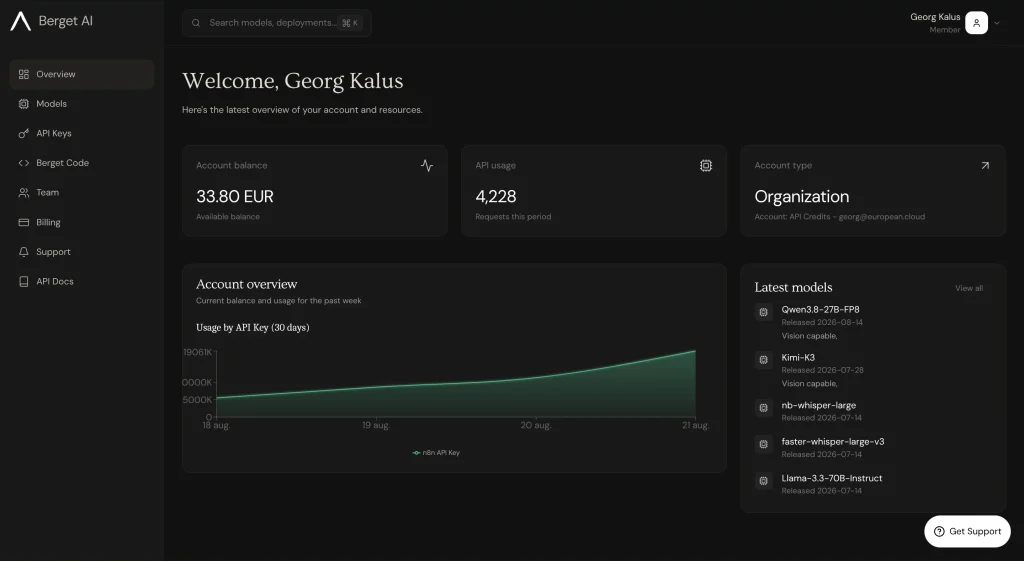
Usage of Berget AI is as simple as it can get with an easy to navigate Console.
A few things I hope to be included in the future:
- more fine-grained analytics. At the moment, I can only see my total token consumption. I would like to see a breakdown by model.
- Energy and water consumption statistics in the console.
- maybe even with a badge about energy and water consumption that I can include in my website. Wouldn’t it be cool to be able to brag about using completely green AI powered by hydropower from Sweden?
Two minor observations I made when I started using Berget AI:
- it seems that the Responses API is not supported yet. The Berget chat API follows the well-established OpenAI chat completions API.
- in the Trial plan seems to have a fairly tight rate limit. When I started using Berget AI on the trial plan and migrated one of my agents, it consistently ran into an error after a while (“Service unavailable” if I remember correctly). Once I changed the Berget AI plan, the agent ran to end without issues.
Berget AI Pricing
Berget AI follows a pre-paid subscription model. You subscribe to a monthly amount of tokens. If you do not use the tokens in a month, they get carried over to the next month. To avoid running out of tokens during the month, you can configure an additional automatic top-up.
I slightly prefer a pay-per-use model where I’m billed monthly for actual token consumption. That said, the pre-pay vs. post-pay distinction is largely psychological, and the other advantages of Berget AI easily outweigh this preference.
Here is a direct like-for-like price comparison of Berget AI with the competition:
 Scaleway Scaleway |  Berget AI Berget AI |  Together AI Together AI | |
| GLM-5.2 Input €/M | €1.80 | €1.40 | €1.40 |
| GLM-5.2 Output €/M | €5.50 | €4.40 | €4.40 |
| gpt-oss-120b Input €/M | €0.15 | €0.20 | €0.15 |
| gpt-oss-120b Output €/M | €0.60 | €0.75 | €0.60 |
| Mistral-Small-3.2-24B-Instruct-2506 Input €/M | €0.15 | €0.30 | – |
| Mistral-Small-3.2-24B-Instruct-2506 Output €/M | €0.35 | €0.30 | – |
| Kimi-K3 Input €/M | – | €3.00 | €3.00 |
| Kimi-K3 Output €/M | – | €15.00 | €15.00 |
How I am using Berget AI
For my agents, I am currently relying on GLM-5.2 and for small and simple tasks gpt-oss-120b. This combination gives me a reasonable price-performance ratio.
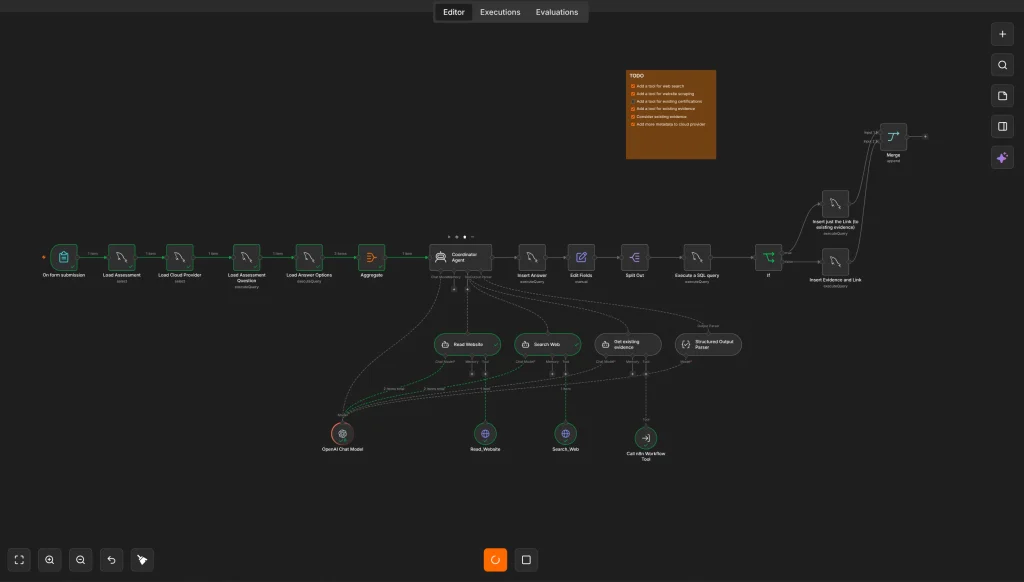
I have a couple of agents for various tasks behind european.cloud. One agent for example helps with the sovereignty assessment that I am including in the cloud provider profiles (see the STACKIT profile as an example). The agent helps to research evidence for the assessment. Other n8n workflows or agents help with posting on Bluesky and LinkedIn and help to stay up to date with the latest news around the European cloud and AI landscape.
Conclusion
Berget AI offers very competitive inference models at a good price with energy and water consumption reported in every response. Usage is as simple as it can get.
I can wholeheartedly recommend Berget AI. To be honest, I am getting a fuzzy feeling knowing that for my AI needs:
- I do not need to compromise on the strength and variety of models.
- I can use inference that is powered by clean energy and the consumption is even reported back to me.
- I am helping to fund a business in Sweden.