Key Takeaways
- The U.S. Commerce Department has imposed export controls on Anthropic’s Mythos 5 and Fable 5 models, forcing a worldwide shutdown for non‑U.S. users.1
- European companies suddenly lost access to the most powerful generative‑AI tools, disrupting development pipelines and cloud‑based services.2
- The ban highlights Europe’s reliance on American AI models and accelerates calls for a sovereign AI ecosystem.4
- EU policymakers, industry bodies and national leaders are urging rapid investment in home‑grown models and regulatory frameworks to avoid future “kill‑switch” scenarios.6
- Companies can mitigate risk by diversifying providers, adopting open‑weight models and building in‑house AI capabilities.8
Introduction
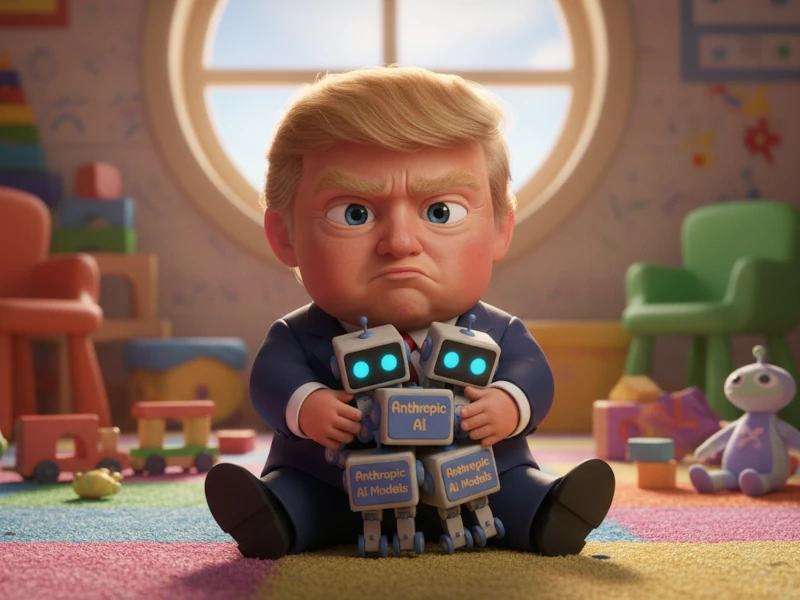
On 13 June 2026 the United States announced export‑control restrictions on Anthropic’s flagship large language models (LLMs) — Mythos 5 and its consumer‑grade variant Fable 5. The directive, issued by Commerce Secretary Howard Lutnick, prohibits any non‑U.S. person or entity from accessing the models, prompting Anthropic to disable them globally in order to remain compliant.2 The abrupt loss of access has immediate operational consequences for European firms that relied on Claude‑based services for product development, cybersecurity research and cloud‑native applications.3
What triggered the U.S. export ban?
According to the Wall Street Journal, the ban stems from “national‑security concerns” raised after Amazon’s internal security team identified potential jailbreak vulnerabilities in Fable 5 that could generate exploitable code for known software weaknesses.2 The findings were reportedly relayed to the Treasury and Commerce departments, leading to a 24‑hour ultimatum for Anthropic to either remediate the issues or block foreign access.1
“The net effect of this order is that we must abruptly disable Fable 5 and Mythos 5 for all our customers to ensure compliance,” Anthropic wrote in a public statement.2
U.S. officials also hinted at a separate intelligence concern: a China‑linked group may have obtained access to Mythos, raising fears that the model could be reverse‑engineered and weaponised.1
Immediate effects on European companies
European users experienced a sudden loss of service across all Anthropic endpoints. Companies that had integrated Claude into internal tools, SaaS products or research pipelines reported:
- Inability to run existing workloads that depended on Claude’s advanced reasoning capabilities.
- Billing continuation for API contracts while the service was offline, creating immediate financial strain.5
- Operational uncertainty for sectors such as cybersecurity, where Anthropic’s models were used for vulnerability analysis.
The ban also exposed a governance gap: Anthropic’s “kill‑switch” was enforced without prior warning or an appeal process, leaving enterprises without a clear remediation path.8
Long‑term strategic implications for EU AI sovereignty
The episode is being cited as a watershed moment in Europe’s discussion of “AI sovereignty.” A Substack analysis by Dave Keating notes that the ban “exposes the painful reality that Europe’s digital infrastructure can be switched off overnight by a foreign government.”4 The same sentiment is echoed in a FAZ interview with cybersecurity expert Mirko Ross, who warned that reliance on frontier AI models without domestic alternatives creates a strategic vulnerability.6
European policymakers are now urging accelerated funding for home‑grown models, such as the EU‑backed “Tech Sovereignty” package announced by Commission President Ursula von der Leyen, and for open‑weight initiatives that can be independently audited.6
Responses from EU policymakers and industry leaders
Several EU figures have publicly reacted:
- German Green MEP Alexandra Geese called the move “a clear example of how the U.S. views Europe as an enemy, not an ally,” and urged immediate investment in European LLMs.4
- Finland’s conservative MEP Aura Salla emphasized that “Europe cannot keep building its tech stack on access that can be switched off overnight by a foreign government.”4
- French liberal MEP Christophe Grudler described the ban as “the latest demonstration of a U.S. kill‑switch that threatens the digital autonomy of the bloc.”4
The European AI Forum, representing more than 3,000 AI firms and researchers, issued a joint statement calling for an “AI sovereignty summit” and a tripling of public investment in European models.6
Options for European firms to mitigate risk
Industry experts recommend a multi‑pronged approach:
- Provider diversification – use multiple AI vendors (e.g., OpenAI, Google Gemini, local open‑source models) to avoid single‑point failures.8
- Open‑weight models – adopt community‑maintained LLMs that can be hosted on‑premise or in EU‑based data centres, ensuring compliance with data‑sovereignty rules.6
- API routing layers – implement a middleware that can switch between providers automatically when one becomes unavailable.8
- Strategic partnerships – collaborate with EU research institutions to co‑develop frontier models and share compute resources.9
- Regulatory engagement – participate in EU policy discussions to shape export‑control frameworks that balance security with market access.4
Conclusion
The Anthropic export ban has instantly illustrated the fragility of Europe’s dependence on U.S. AI infrastructure. While the immediate disruption is costly for companies that depended on Claude, the longer‑term effect may be a catalyst for a coordinated European effort to build indigenous, transparent AI models. Policymakers, industry groups and individual firms appear poised to act, but the speed and scale of investment will determine whether Europe can avoid future “kill‑switch” scenarios and achieve genuine AI technological sovereignty.
References
[^1]: Anthropic export ban exposes Europe’s AI sovereignty gap. YouTube. Retrieved 18 June 2026.
[^2]: Amrith Ramkumar & Robert McMillan (2026‑06‑13). “Anthropic Halts Access to Top AI Models After U.S. Ban on Foreign Use“. The Wall Street Journal. Retrieved 18 June 2026.
[^3]: Times News (2026‑06‑17). “US Ban On Anthropic AI Models Forces Europe To Sit And Watch“. YouTube. Retrieved 18 June 2026.
[^4]: Dave Keating (2026‑06‑16). “As Trump bans Europeans from using Anthropic, the EU’s US dependence is painfully on display“. Substack. Retrieved 18 June 2026.
[^5]: Damian Boeselager (2026‑06‑15). “Trump’s order to ban the use of Anthropic’s most powerful AI models (Mythos and Fable 5) to non‑US citizens is a sobering reminder“. Facebook. Retrieved 18 June 2026.
[^6]: Julia Bauer‑Ross (2026‑06‑16). “What the Anthropic ban really means for European companies | Mirko Ross in FAZ“. Asvin. Retrieved 18 June 2026.
[^7]: Damian Boeselager (2026‑06‑15). “Trump’s order to ban the use of Anthropic’s most powerful AI models (Mythos and Fable 5) … Europe is heavily dependent on American tech“. Facebook. Retrieved 18 June 2026.
[^8]: Reddit user ur_frnd_the_footnote (2026‑04‑22). “PSA: Anthropic bans organizations without warning“. Reddit. Retrieved 18 June 2026.
[^9]: Trending Topics EU (2026‑06‑15). “The Anthropic Ban Just Made Europe’s AI Dependency Impossible to Ignore“. TrendingTopics.eu. Retrieved 18 June 2026.
[^10]: Instagram (2026‑06‑15). “Create an account or log in to Instagram – Share what you’re into with the people who get you“. Instagram. Retrieved 18 June 2026.