Key Takeaways
- Europe’s AI ecosystem is bolstered by strong industrial expertise, abundant data and growing investment in “physical” AI applications.
- Major European firms such as SAP argue the continent should double‑down on industrial AI rather than chase large‑language models.
- EU regulators are tightening oversight of AI investments, especially large generative‑AI projects like the proposed gigafactories.
- Several European think‑tanks and research bodies are pursuing alternative AI models that focus on niche, data‑rich domains.
- Policy recommendations stress coordinated funding, regulation reform, and a shift toward sector‑specific AI adoption to keep Europe competitive.
Physical AI – Europe’s Industrial Edge
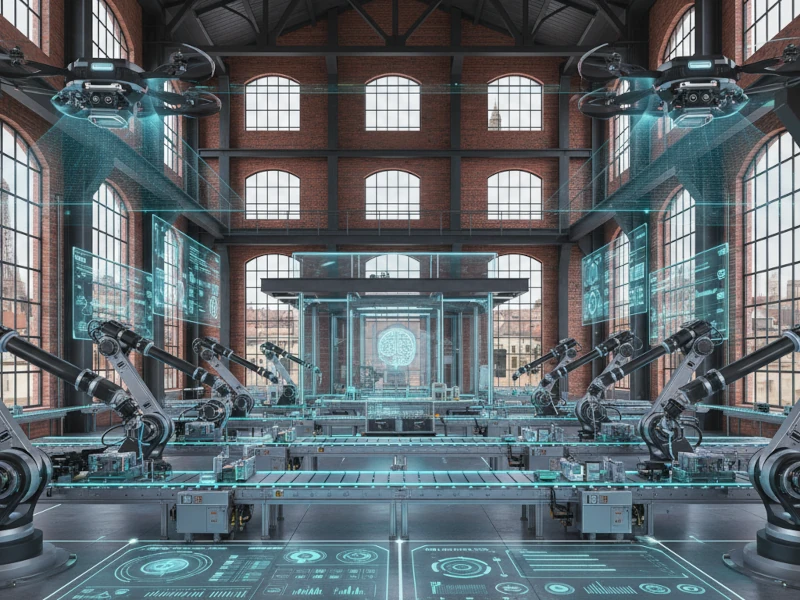
According to a World Economic Forum analysis, the continent’s historic strength in engineering and manufacturing positions it well to lead in “physical AI,” where AI systems are embedded in supply chains, robotics and production equipment rather than purely in large language models.[6] The report argues that high‑labour‑cost economies benefit most from this approach, delivering faster and more predictable returns.[6]
SAP’s board member Thomas Saueressig echoed this view, stating that “artificial intelligence for use in industry is ‘where I believe Europe can succeed big time around the globe’.”[7] He highlighted Europe’s “industrial knowledge and the industrial data and competency we have” as the foundation for scaling industrial AI solutions.[7]
“The silver bullet isn’t new tech; it’s collaboration.” – World Economic Forum analysis.[6]
European firms are already piloting AI‑driven robotics: BMW recently introduced two AI‑powered humanoid robots on a German production line, while Deutsche Telekom and Nvidia launched a “sovereign AI platform” aimed at reducing dependence on U.S. and Chinese technology providers.[7][6]
Investment Landscape and Regulatory Scrutiny
The European Commission has earmarked up to €20 billion for AI gigafactories—large data‑center clusters intended to train frontier AI models.[4] However, three independent reports criticised the plan as potentially over‑hyped, citing weak demand forecasts, high energy costs and the risk of “cathedrals in the desert.”[4] The European Parliament’s Research Service warned that scaling generative AI may face diminishing returns and reliability issues.[4]
Bloomberg reported that the EU’s powerful regulatory arm is intensifying scrutiny of big‑tech AI projects, a development that could reshape funding flows and market dynamics.[3] This regulatory focus aligns with the Institute for the Future’s recommendation that Europe must reform fragmented markets, harmonise digital rules and secure at least 10 % of global compute capacity to remain competitive.[10]
Despite these challenges, Europe retains significant financial buffers: households save roughly €1.4 trillion annually, representing a pool of under‑used capital that could be mobilised for AI investments if appropriate incentives are put in place.[10]
Beyond Large Language Models – Alternative AI Paths
Some commentators observed that, while the United States is enamoured with massive LLMs, European AI experts are exploring “approaches beyond large language models.”[9] Projects such as Germany’s SPRIN-D initiative focus on domain‑specific AI, leveraging Europe’s rich, high‑quality data sets for applications in manufacturing, logistics and healthcare.[9]
The Institute for the Future also stresses the importance of “physical AI” and data‑sharing platforms—shared, anonymised industrial datasets that enable Europe’s “digital twins” and simulation environments, thereby reducing model brittleness and accelerating innovation.[10]
Strategic Implications and Policy Recommendations
Collectively, the sources converge on a set of policy actions necessary for Europe to translate its AI potential into global leadership:
- Regulatory reform – Streamline AI‑related rules, create fast‑track pathways for high‑risk industrial pilots, and harmonise safety standards across member states.[3][4][10]
- Infrastructure investment – Ensure at least 10 % of world‑wide compute capacity resides in Europe, and expand low‑cost, green energy to power data centres.[10]
- Data sharing ecosystems – Build interoperable, privacy‑compliant industrial data spaces to support “digital twins” and sector‑specific AI models.[6][10]
- Talent development – Align university curricula with AI‑first skill sets, increase funding for AI research, and retain top talent through competitive remuneration.[10]
- Export of European AI stacks – Promote Europe’s mature digital‑government infrastructure (e‑ID, e‑Gov) abroad, positioning the continent as a trusted provider of AI‑enabled public services.[6][8]
These recommendations echo the Institute’s call for a coordinated European response that involves the EU‑27, the United Kingdom, Norway, Switzerland and Ukraine, recognising that many of the required levers lie outside the EU’s formal jurisdiction.[10]
Conclusion
Europe’s AI sector is anchored by deep industrial expertise, abundant data assets and a growing appetite for “physical” AI solutions. While regulatory scrutiny and fragmented markets pose challenges, coordinated policy action—focused on infrastructure, data sharing, talent, and export of trusted AI stacks—could convert Europe’s latent strengths into a sustainable competitive advantage. The coming years will test whether Europe can translate its collaborative approach into concrete leadership in the global AI arena.[6][10]
References
- [^1]: Europe is stronger in AI than you might think. YouTube Shorts. February 27, 2026. Retrieved March 13, 2026.
- [^2]: Europe’s relationship with technology is evolving 🚀. Instagram Reel (IE University). March 5, 2026. Retrieved March 13, 2026.
- [^3]: Big Tech’s Emerging Grip on AI Is Drawing EU Scrutiny. Bloomberg. March 12, 2026. Retrieved March 13, 2026.
- [^4]: Trio of reports say the EU is betting too heavily on generative AI. Science Business. December 4, 2025. Retrieved March 13, 2026.
- [^5]: Europe’s AI ambition is clear. But is it ready?. Nokia (Facebook). January 27, 2026. Retrieved March 13, 2026.
- [^6]: Europe can still win with AI, the key is focusing on physical AI. World Economic Forum. January 20, 2026. Retrieved March 13, 2026.
- [^7]: Europe should focus on industrial AI, SAP says. The Economic Times. March 4, 2026. Retrieved March 13, 2026.
- [^8]: Europe in the Global AI Race. Morgan Stanley (YouTube). November 13, 2025. Retrieved March 13, 2026.
- [^9]: AI: Why Europe is now pursuing approaches beyond large language models. Table.Briefings. January 12, 2026. Retrieved March 13, 2026.
- [^10]: Europe in the Age of AI: How Technology Leadership Can Boost Competitiveness and Security. Institute for the Future. November 17, 2025. Retrieved March 13, 2026.