Exoscale is a cloud platform with its center of gravity in Switzerland and Austria. Selling points for Exoscale are engineering mindset, Open Source culture and products, data security, GDPR compliance, data privacy and good geographical distribution of data centres.
Features & Services
The service portfolio of Exoscale is a straightforward set of IaaS services. All of the services are built on raw Open Source products, which means that lock-in with Exoscale is low. On the other hand, a lot may have to be built on top of the basic building blocks provided by Exoscale.
The DBaaS services of Exoscale seem to be powered by Norwegian Aiven, a mature cloud-scale platform for managed Kafka and various other managed databases.
Developer Experience
There are several ways to interact with the Exoscale platform.
Console
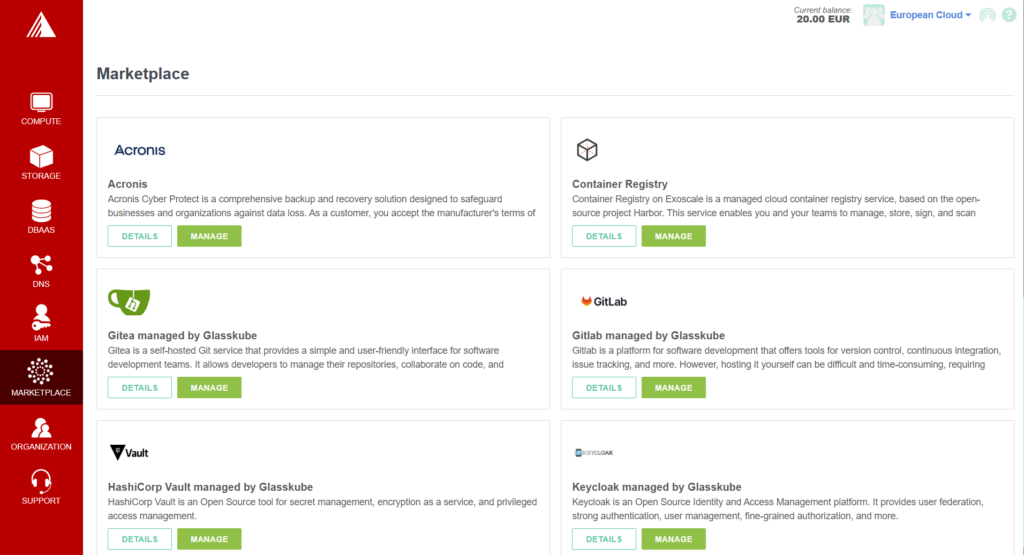
The Exoscale Console is well-ordered and easy to get around.
API
Behind libraries, CLI, Terraform and all other ways to interact with Exoscale lies the Exoscale API.
CLI
The Exoscale Command Line Interface (CLI) covers the whole surface and is well-structured and easy to understand and work with.
For more information, check the documentation of the Exoscale CLI.
Terraform
The Exoscale Terraform provider is published in the Terraform Registry, along with it’s documentation.
The first steps to set up the Exoscale Terraform provider with credentials and a container for the Terraform state are described in the Exoscale Terraform provider documentation.
SDKs
There is a larger-than-average number of official libraries to work with Exoscale resources.
| egoscale | The Golang library for Exoscale. | egoscale on GitHub |
| python-exoscale | Python bindings for the Exoscale API. | python-exoscale on GitHub |
| exoscale-sdk-java | Java API for Exoscale services. | exoscale-sdk-java on GitHub |
| pulumi-exoscale | Pulumi provider to manage Exoscale resources. | pulumi-exoscale on GitHub |
| crossplane-exoscale | Crossplane provider to manage Exoscale resources. | crossplane-exoscale on GitHub |
Data Centres
Exoscale has data centres in Switzerland, in Austria, in Germany and in Bulgaria. According to Exoscale “Several peering connections with major local actors grant first in class performance in our geographical area”. The data centres are:
| Name | City | Country |
|---|---|---|
| DE-MUC-1 | Munich | Germany |
| BG-SOF-1 | Sofia | Bulgaria |
| HR-ZAG-1 | Zagreb | Croatia |
| CH-DK-2 | Zurich | Switzerland |
| CH-GVA-2 | Geneva | Switzerland |
| AT-VIE-1 | Vienna | Austria |
| AT-VIE-2 | Vienna | Austria |
| DE-FRA-1 | Frankfurt | Germany |
More information about the data centres can be found here: Exoscale Data Centres. A map with the geograpical location of the data centres can is here.
Environmental Policy
Exoscale is basing its environmental policy on several measures
- Renewable Energy
- High Density Rack Design
- Refurbished Equipment
- Extended Server Fleet Life
- Energy-Efficient Design
- Direct Shipping
- Work Policies
All the details about the Exoscale environmental policy are documented on the Exoscale Sustainability page.
Certifications
Over the course of their history, Exoscale have managed to obtain a large number of certifications. These include the basic security certifications as well as a few special, industry-specific ones, such as HDS, TISAX and HIPAA.
All the certifications, standards and frameworks that Exoscale complies with are listed on the Exoscale Compliance page.
Conclusion
As they claim themselves, Exoscale are offering a solid cloud platform. They have a good distribution of data centers to fulfill data residency and geo-redundancy requirements.
Regarding features and services, the Exoscale offering is a solid IaaS range but does not stick out compared to other players. Higher-level services are absent completely as of now and require a lot of platform work by the customer (with the notable exception of a managed Kafka service – something that many others are not offering).
A positive twist to this is that the Exoscale services are “just” repackaged Open Source – it should be relatively easy to move in and out and mix and match with Exoscale.