Key Takeaways
- Black Forest Labs (BFL), founded by Robin Rombach, is now positioned as the biggest rival to Google in AI‑generated images.
- The company’s flagship FLUX model family delivers high‑quality, consistent visual output and is offered under permissive open‑source licences.
- A $300 million Series B round valued BFL at $4 billion, fueling rapid expansion and deepening enterprise partnerships with Adobe, Canva, Meta, and others.
- European AI leadership is a core narrative, with BFL showcasing how cutting‑edge research can emerge outside Silicon Valley.
- Future growth will hinge on scaling video‑generation capabilities, improving multi‑GPU inference efficiency, and expanding B2B integrations.
Introduction
In a recent interview, Black Forest Labs co‑founder Robin Rombach declared, “We are now the largest competitor to Google in AI images.” The statement captures a rapid evolution from a university research project in Freiburg to a globally valued AI powerhouse. Leveraging the latent diffusion techniques that powered Stable Diffusion, BFL has built the FLUX family of models—open‑source, high‑fidelity image generators that serve both developers and large enterprises.
Background and Founding of Black Forest Labs
Robin Rombach, together with former Stability AI researchers Patrick Esser and Andreas Blattmann, founded Black Forest Labs in early 2024. The trio previously authored the latent diffusion models that later became the foundation of Stable Diffusion, a breakthrough that democratized text‑to‑image generation worldwide.[^5] Drawing on that expertise, they established BFL in Freiburg, Germany, with the ambition to create next‑generation visual AI while keeping research openly accessible.
FLUX: Open‑Source Strategy and Technical Edge
The first publicly released model, FLUX 1.0, introduced a diffusion‑transformer architecture with improved positional embeddings (ROPE) and hardware‑efficient kernels, delivering faster generation without sacrificing quality.[^5][^1] Subsequent releases—FLUX 2.0 and a fast “FLUX Schnell” variant—offer sub‑second inference for short prompts, while larger, undistilled versions retain the highest fidelity for professional workflows.[^4][^7]
The FLUX Schnell variant is available at the IONOS AI Model Hub.
“Our philosophy is to keep the research transparent and the model weights freely available, which we believe ultimately makes the technology safer and more innovative.” – Robin Rombach
The open‑weight approach has attracted a vibrant ecosystem of developers, enabling rapid experimentation and fostering community‑driven improvements such as negative prompting and style consistency.[^5]
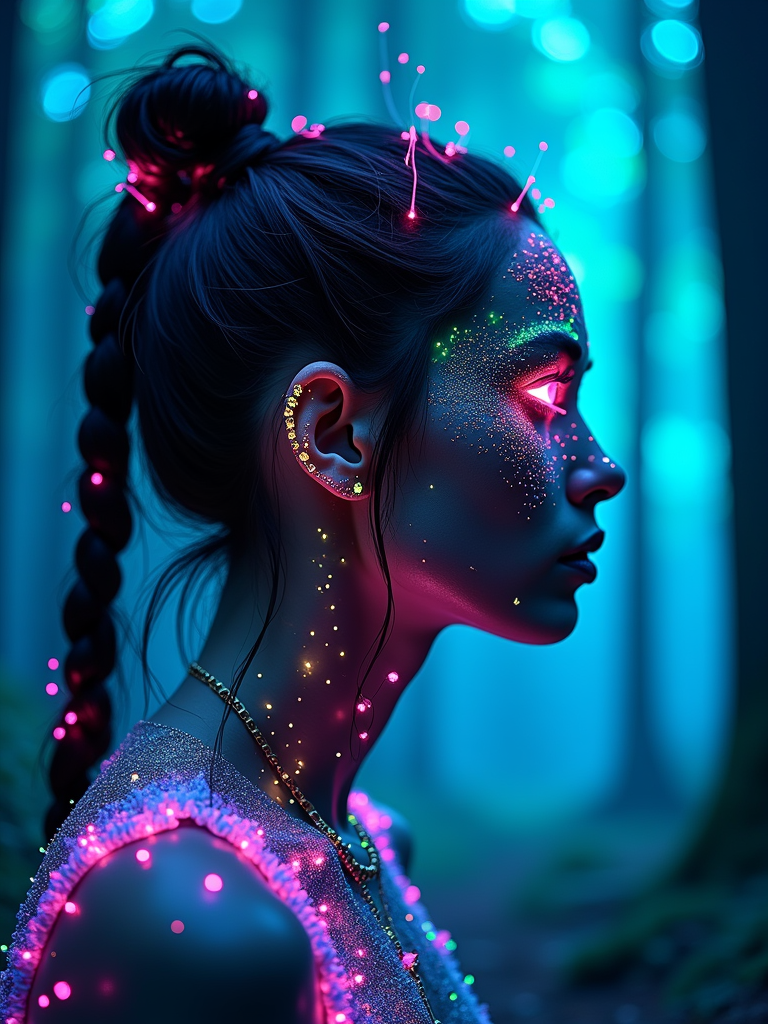
Some examples of what FLUX.1 can do can be seen below (find the corresponding prompts here).





Competing with Google: Market Position
Google’s Imagen and Parti models dominate the proprietary side of AI image generation, often hidden behind cloud APIs. Black Forest Labs differentiates itself by offering permissive licenses, on‑premise deployment options, and a focus on enterprise‑grade consistency—features critical for brands that require repeatable visual identity across campaigns. BFL’s FLUX models have become the de-facto “go‑to solution” for major players seeking reliable image generation at scale, directly challenging Google’s market share in this segment.[^4]
Funding Milestones and Strategic Partnerships
In December 2025, BFL closed a $300 million Series B round led by Andreessen Horowitz and Notion Capital, pushing the company’s valuation to $4 billion.[^7][^10] The round also secured a multi‑year $140 million partnership with Meta, integrating FLUX into Instagram and Facebook’s creative tools.[^10] Existing collaborations with Adobe, Canva, and Snap further illustrate the company’s B2B focus and its role as a core component of modern design pipelines.[^4][^7]
Financially, BFL reported $96.3 million in annual recurring revenue (ARR) in August 2025, with projections to exceed $300 million by 2026, underscoring the rapid monetization of its open‑source model strategy.[^7]
Future Outlook: Video Generation and Scaling Challenges
Beyond static images, BFL is investing heavily in video generation. A cross‑interview with Thomas Wolf of Hugging Face highlighted the company’s “turn‑by‑turn editing” capabilities and the development of a latent video model that promises higher motion fidelity and longer runtimes than earlier solutions like Stable Video Diffusion.[^1] Scaling such models across multiple GPUs remains a technical bottleneck; BFL’s engineering team is working to achieve near‑linear performance gains as GPU count grows.[^6]
As the AI market continues to mature, the company’s open‑source stance may set industry standards for transparency and safety, while its enterprise deals ensure a sustainable revenue base that can fund further research and infrastructure expansion.
Conclusion
Black Forest Labs exemplifies how deep research roots, an open‑source ethos, and aggressive commercial execution can propel a European AI startup to challenge the dominance of industry giants like Google. With a $4 billion valuation, robust enterprise partnerships, and a roadmap that includes advanced video generation, BFL is poised to shape the next wave of generative visual media. Continued focus on multi‑GPU efficiency and strategic collaborations will determine how far the company can extend its leadership in the rapidly evolving AI landscape.
References
- [^1]: AI of the Hurricane | Thomas Wolf (Hugging Face) & Robin Rombach (Black Forest Labs) (Nov 26, 2025). “AI of the Hurricane“. YouTube. Retrieved January 5, 2026.
- [^2]: YouTube (Oct 15, 2025). “Interview with Andreas Blattmann, BFL co-founder“. YouTube. Retrieved January 5, 2026.
- [^3]: Reddit (Aug 18, 2024). “Podcast interview with the founders of Black …“. Reddit. Retrieved January 5, 2026.
- [^4]: Tim Höttges (Dec 1, 2025). “Top AI Made in the Black Forest“. LinkedIn. Retrieved January 5, 2026.
- [^5]: Alessandro Perilli (Aug 18, 2024). “Black Forest Labs on FLUX“. perilli.com. Retrieved January 5, 2026.
- [^6]: Gorkem Yurtseven (Oct 22, 2025). “The pivot that paid off: How Fal found explosive growth in generative media“. First Round Review. Retrieved January 5, 2026.
- [^7]: Notion Capital (Dec 1, 2025). “Why we invested in Black Forest Labs“. Notion Capital. Retrieved January 5, 2026.
- [^8]: Robin Rombach (Nov 27, 2024). “Robin Rombach: Co‑founder @Black Forest Labs, Building Leading AI Models From Europe | Slush 2024“. YouTube. Retrieved January 5, 2026.
- [^9]: Medium (Aug 24, 2025). “AI image generation enters new golden age as competition heats up and technology breakthroughs“. Medium. Retrieved January 5, 2026.
- [^10]: tradedvc (Sep 30, 2025). “Black Forest Labs secures $140 M partnership with Meta, raises valuation to $4 B“. Instagram. Retrieved January 5, 2026.
- [^11]: Unspecified Author (Aug 24, 2025). “AI image generation enters new golden age as competition heats up and technology breakthroughs“. Medium. Retrieved January 5, 2026.