Key Takeaways
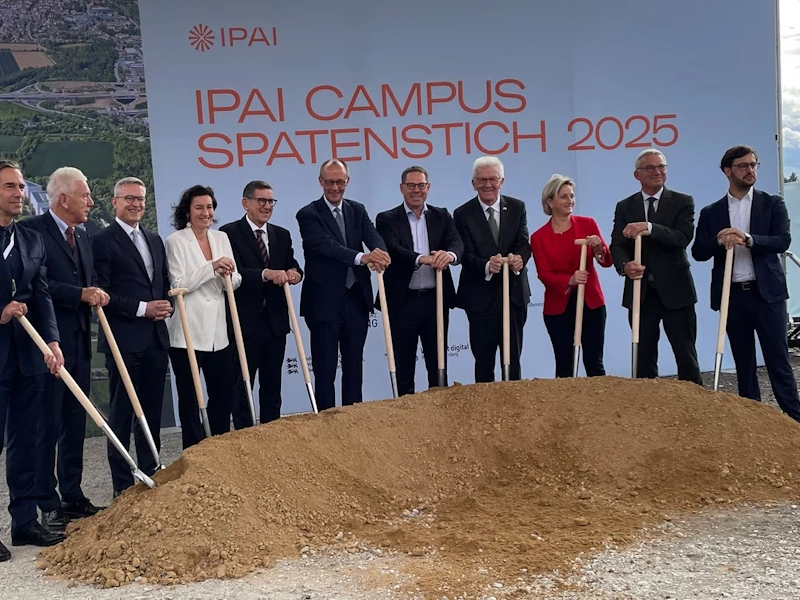
- Federal Chancellor Friedrich Merz and Baden‑Württemberg Minister‑President Winfried Kretschmann broke ground on the €3 billion Innovation Park Artificial Intelligence (IPAI) campus in Heilbronn.
- The 30‑hectare, circular campus is designed by Dutch firm MVRDV and targets more than 5,000 AI‑related jobs by 2027.
- Funding combines €50 million from the state, €50 million from the Dieter Schwarz Stiftung and major private investment from the Schwarz Group.
- Over 80 partner organisations – including Audi, SAP and Deutsche Telekom – will occupy start‑up labs, research facilities and a “Mobility Hub”.
- IPAI is positioned as Europe’s largest AI campus, supporting Germany’s strategic push for AI sovereignty, responsible AI and digital competitiveness.
Introduction
The inauguration of the Innovation Park Artificial Intelligence (IPAI) marks a decisive step in Germany’s ambition to become a leading European hub for artificial intelligence. On 21 October 2025, Chancellor Friedrich Merz and Baden‑Württemberg’s Premier Winfried Kretschmann cut the first stone of a €3 billion, 30‑hectare campus in Heilbronn that will host more than 5,000 AI professionals, state‑of‑the‑art laboratories, and a public “Mobility Hub” [^7][^9]. Backed by public and private capital, the project aims to fuse research, industry and society under one roof, creating what officials describe as the “global home of human AI” [^8].
Project Overview and Funding
IPAI is a public‑private partnership between the State of Baden‑Württemberg, the Dieter Schwarz Stiftung, the Schwarz Group and the City of Heilbronn [^5][^3]. The financial package comprises:
- €50 million from the state of Baden‑Württemberg.
- €50 million contributed by the Dieter Schwarz Stiftung.
- The Schwarz Group as the primary private investor, providing the bulk of the €3 billion total budget.
The consortium—referred to as the IPAI Konsortium—has already attracted more than 80 corporate and academic partners, ranging from automotive giant Audi to software leader SAP, signaling broad industrial support for the initiative [^5][^1].
Architecture and Sustainable Design
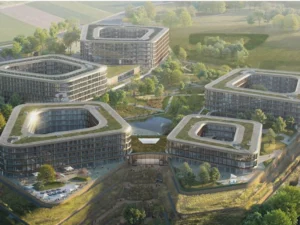
The campus masterplan, executed by the Dutch architectural studio MVRDV, features a distinctive circular layout intersected by two off‑centre axes, creating a cohesive yet open environment for collaboration [^1][^3][^4]. Key buildings include:
- Communications Centre – a 60‑metre tall cylindrical tower with a reflective façade that will serve as the public heart of the campus, hosting exhibitions, conferences and seminars [^4].
- Mobility Hub – a spacious atrium‑based structure that connects visitors to micromobility services and underground logistics [^4][^8].
- Start‑up & Innovation Centre – a bright‑red volume with pitched roofs and a central green courtyard designed for informal collaboration [^4][^8].
- Living Lab – a hybrid timber building that offers panoramic lab spaces for real‑world AI testing [^4][^8].
- Ten‑storey Office Building – featuring pleated façades with integrated photovoltaic panels, aiming for DGNB Platinum sustainability certification [^4][^8].
MVRDV emphasised a human‑centred approach, creating car‑free streets, abundant greenery and tactile materials to counterbalance the technical intensity of AI work [^1][^4]. The firm employed its CarbonSpace tool to monitor embodied carbon and pursued low‑carbon, bio‑based construction methods, targeting DGNB Platinum certification for several structures [^4].
Stakeholder Involvement and Jobs Creation
Beyond the architectural landmark, IPAI is designed as an economic catalyst. The consortium expects the campus to generate 5,000 AI‑related jobs across research, development, and service sectors [^5][^1]. Notable partners include:
- Audi – contributing automotive AI expertise.
- SAP – focusing on enterprise‑level AI solutions.
- Deutsche Telekom – joining the platform in May 2025 to accelerate network‑AI integration [^5][^13].
- Numerous SMEs and start‑ups, which will share co‑working spaces to foster cross‑disciplinary innovation.
The presence of these firms, together with academic branches from German universities planned for the site, will deepen the regional talent pool and support Germany’s broader AI workforce strategy [^5][^6].
Strategic Importance for Germany and Europe
IPAI aligns with the German Federal Government’s AI strategy of “technological sovereignty, ethical leadership and strategic competitiveness” [^6]. By consolidating research, industry and public‑sector actors in a single campus, Germany aims to:
- Reduce dependence on non‑European AI providers, strengthening digital sovereignty.
- Promote responsible AI development, echoing EU regulations on AI safety and ethics.
- Position Europe as a global AI hub, complementing EU initiatives such as AI “gigafactories” backed by the European Investment Bank [^2].
Some commentators are highlighting IPAI as a “core component of Germany’s emerging AI strategy” that could shift the balance of AI leadership from the United States and China toward Europe [^6]. The campus also serves as a model for sustainability, integrating renewable energy, green spaces and low‑carbon construction—key criteria for the EU’s green‑digital transition [^4][^8].
Timeline and Future Outlook
The groundbreaking ceremony in October 2025 officially launched construction, with the first phase—including the communications centre, mobility hub, start‑up centre and office building—scheduled for completion by the end of 2027 [^5][^8]. Subsequent phases will expand the campus to accommodate additional research labs, data‑center infrastructure and educational facilities, including Europe’s largest programming school aimed at upskilling the future AI workforce [^6].
Given the high‑profile political backing, the involvement of leading corporations and the ambitious sustainability goals, IPAI is poised to become a benchmark for AI ecosystems worldwide.
Conclusion
The launch of the €3 billion IPAI campus signifies Germany’s concrete commitment to shaping Europe’s AI future. By uniting public funding, private investment and world‑class design, the project not only creates thousands of jobs but also embeds responsible, sustainable AI development at its core. As the first buildings rise on Heilbronn’s Steinäcker site, IPAI will likely serve as a catalyst for further AI investments across the continent, reinforcing Europe’s quest for digital sovereignty and technological leadership.
References
[^1]: MVRDV (Oct 22, 2025). “The global home of human AI: German Chancellor Friedrich Merz breaks ground for MVRDV‑designed IPAI CAMPUS“. MVRDV News. Retrieved 1 February 2026.
[^2]: Matthew Baynes (Nov 6, 2025). “European Commission partners with EIB and EIF to boost AI infrastructure“. LinkedIn. Retrieved 1 February 2026.
[^3]: Reyyan Dogan (Oct 27, 2025). “MVRDV Breaks Ground on the Innovation Park Artificial Intelligence Campus in Heilbronn, Germany“. ArchDaily. Retrieved 1 February 2026.
[^4]: Kat Barandy (Oct 22, 2025). “MVRDV breaks ground on innovation park in Germany, ‘the global home of human AI’“. Designboom. Retrieved 1 February 2026.
[^5]: Wikipedia contributors (Sep 27, 2025). “Innovation Park Artificial Intelligence“. Wikipedia. Retrieved 1 February 2026.
[^6]: SpecialEurasia (Nov 17, 2025). “Germany’s Bid for AI Leadership: The IPAI Experiment“. SpecialEurasia. Retrieved 1 February 2026.
[^7]: Deutschland.de (Oct 22, 2025). “Europe’s largest AI campus, the Innovation Park Artificial Intelligence (IPAI), is taking shape in Heilbronn“. Threads. Retrieved 1 February 2026.
[^8]: IPAI (Jul 9, 2025). “The Global Home of Human AI“. IPAI. Retrieved 1 February 2026.
[^9]: German Embassy Washington (Oct 21, 2025). “German Embassy Washington – Groundbreaking of the Innovation Park AI (IPAI) campus in Heilbronn“. Facebook. Retrieved 1 February 2026.
[^10]: deutschland.de (Mar 6, 2024). “Heilbronn is becoming home to one of the most important AI ecosystems in Europe“. Deutschland.de. Retrieved 1 February 2026.