Key Takeaways
- Lidl parent Schwarz Group, through its cloud arm STACKIT, is planning a €11‑€13 billion AI‑focused data‑center campus in Lübbenau, Brandenburg.
- The site will span 13 hectares, host up to 200 MW of power capacity and house up to 100 000 AI chips, making it one of Europe’s largest “AI gigafactories”.
- Construction is slated to start in 2025 with the first facility operational by end‑2027.
- The project is pitched to the German government to secure a share of the EU’s €20 billion AI‑gigafactory fund and to advance Europe’s digital sovereignty agenda.
- Key stakeholders include Schwarz Group founder Dieter Schwarz, STACKIT CEO Bernd Wagner, Germany’s Digital Minister Karsten Wildberger, and partners such as Deutsche Telekom and SAP.
Introduction
The Schwarz Group – the privately held conglomerate behind Lidl and Kaufland – announced plans to build a massive AI‑focused data‑center campus in Lübbenau, south of Berlin. Leveraging its STACKIT cloud platform, the venture will invest “billions of euros” to create a hyperscale facility capable of supporting up to 100 000 AI chips and offering cloud services to external customers. The proposal, presented to the German government in July 2025, aims to tap into the European Union’s €20 billion AI‑gigafactory programme and reinforce Europe’s push for digital sovereignty.[1][^1]
Project Overview
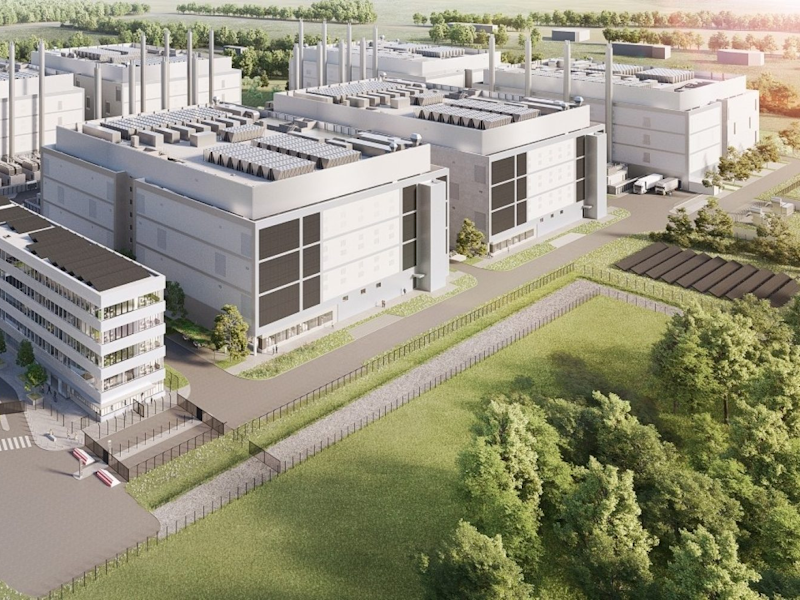
The planned campus will cover roughly 13 hectares and be graded for a total power capacity of 200 MW, distributed across multiple buildings. The first data‑center is expected to be ready by the end of 2027, with the broader campus becoming fully operational in the early 2030s.[7][^7][9][^9] The site is adjacent to an existing Kaufland logistics centre that has been in operation since 1996, providing immediate access to robust infrastructure and local utilities.
“The retailer is expected to present its multibillion‑euro investment plan to the government on July 11, 2025… This initiative supports Germany’s goal to secure part of the €20 billion EU subsidies for AI ‘gigafactories’.”
— Bloomberg, July 10 2025[1][^1]
Strategic Motivation and Digital Sovereignty
European policy makers have framed digital autonomy as a matter of national security rather than merely economic preference. Bernd Wagner, CEO of STACKIT, emphasized that reliance on US cloud providers poses “survival” risks amid geopolitical tensions.[8][^8] The German Digital Ministry, led by Karsten Wildberger, has positioned the project alongside similar bids from Deutsche Telekom and SAP to reduce “technological dependencies” and to keep AI, cloud, semiconductor, and cybersecurity expertise inside Europe.[5][^5][10][^10]
Technical Specifications and Timeline
- Power capacity: Up to 200 MW, enabling large‑scale AI training workloads.
- Physical footprint: 13 hectares (≈32 acres) in Lübbenau, Brandenburg.
- AI hardware: Provision for up to 100 000 AI chips, positioning the campus among the continent’s largest AI compute sites.
- Construction phases: Initial building scheduled for completion by end‑2027; subsequent phases to expand capacity through the early 2030s.
- Heat recovery: Waste heat will be supplied to the local municipality, supporting regional sustainability goals.
STACKIT, the cloud arm of Schwarz Digits, already operates seven data‑centers in Germany and Austria and plans to invest billions further to expand its sovereign‑cloud offering.[6][^6][8][^8]
Funding, Partnerships, and EU AI Gigafactory Programme
The campus is expected to be financed primarily by Schwarz Group’s internal capital, supplemented by potential EU subsidies under the Invest‑AI initiative. The EU has attracted 76 expressions of interest for AI gigafactories, representing projected investments of over €230 billion and more than three million GPUs across the continent.[5][^5][10][^10]
Strategic partners include:
- Deutsche Telekom – cooperating on connectivity and digital sovereignty initiatives.
- SAP – potential integration of enterprise cloud services.
- Google – a recent partnership to provide sovereign cloud storage for Workspace customers.[9][^9]
Stakeholder Reactions
Industry analysts view the project as a “retail‑to‑tech” pivot, echoing Amazon’s evolution from e‑commerce to cloud services. The initiative aligns with Germany’s €1.7 billion national AI investment plan and complements broader EU efforts to curtail dependence on foreign technology providers.[3][^3][5][^5]
Conclusion
The Schwarz Group’s AI data‑center project marks a significant expansion of a traditional retailer into high‑performance computing and cloud services. By anchoring the campus in Germany and tying it to EU funding, the venture reinforces Europe’s strategic goal of digital sovereignty while offering a new revenue stream for the conglomerate. If successful, the Lübbenau campus could become a central hub for AI research and commercial workloads, shaping the continent’s competitive landscape in the emerging AI economy.
References
- [^1]: Kyriasoglou, Christina (2025-07-10). “Billionaire Lidl Owner Wants to Build Major AI Data Center in Europe“. Bloomberg. Retrieved 2025-11-17.
- [^2]: “Schwarz AI Gigafactory Pushes German Sovereignty, Tests Water Limits” (2025-08-19). “Schwarz AI Gigafactory Pushes German Sovereignty, Tests Water Limits“. Bluefield Research. Retrieved 2025-11-17.
- [^3]: “German retailer Schwarz Group plans major AI data center” (2025-07-11). “German retailer Schwarz Group plans major AI data center“. Techinasia. Retrieved 2025-11-17.
- [^4]: Agnew, Richard (2025-11-14). “DT seeks ‘strong partners’ for German AI mega-hub pitch“. TelcoTitans. Retrieved 2025-11-17.
- [^5]: Vainilavičius, Justinas (2025-07-11). “Lidl owner eyes “AI gigafactory” in Europe“. Cybernews. Retrieved 2025-11-17.
- [^6]: Hoeijmakers, Rob (2025-08-13). “From Shopping Cart to Server Rack: How Lidl Builds a European Cloud“. Hoeijmakers.net. Retrieved 2025-11-17.
- [^7]: Introl (2025-01-10). “Lidl’s parent company set to build 200MW German datacenter“. LinkedIn. Retrieved 2025-11-17.
- [^8]: Dees, Mels (2025-08-04). “Lidl owner builds European sovereign cloud“. Techzine. Retrieved 2025-11-17.
- [^9]: Swinhoe, Dan (2025-01-07). “Lidl owner plans 200MW data center campus in Lübbenau, Germany“. DataCenterDynamics. Retrieved 2025-11-17.
- [^10]: “German firms to submit separate EU bids for AI data centre … – Reuters” (2025-06-19). “German firms to submit separate EU bids for AI data centre …“. Reuters. Retrieved 2025-11-17.